

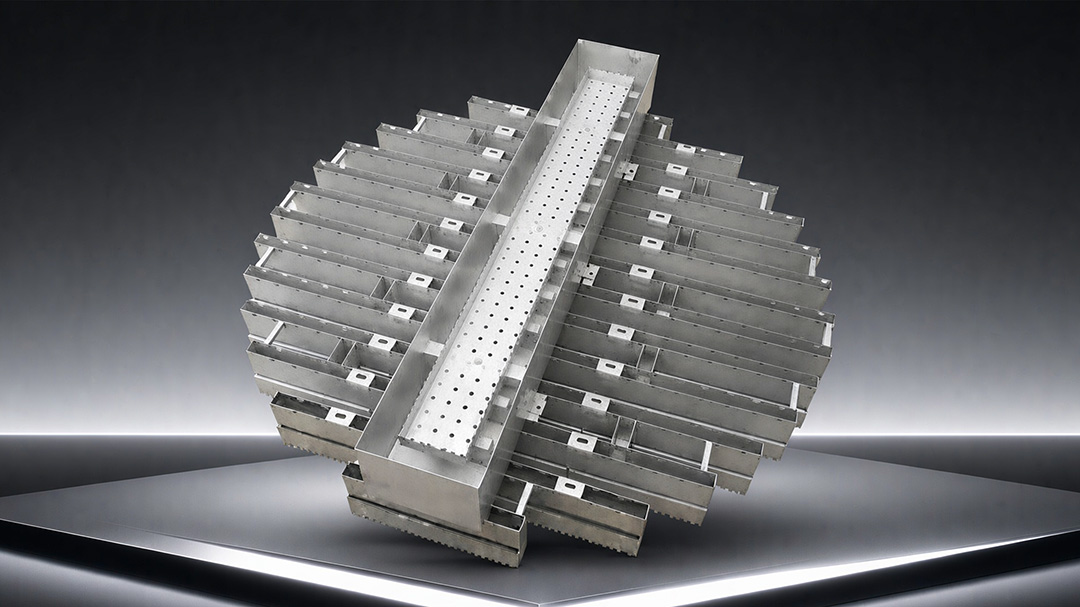
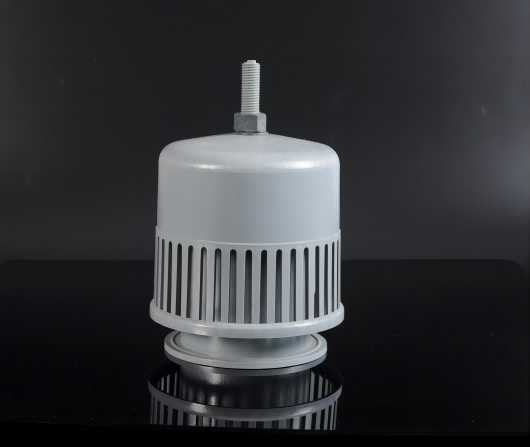
Figure 1: Trough and orifice-pan distributors — gravity types dominate packed-column tops because drip-point control decides bed efficiency.
Engineer's Brief: A liquid distributor is the single internal that decides whether expensive packing actually wets uniformly. Classify first as gravity (orifice pan, drip-tube, trough) or pressure (pipe-ladder, spray nozzle). Gravity types give better distribution quality and higher turndown; pressure types are cheaper and freer for vapor but clog faster. FXSINO fabricates distributors to tower ID, liquid rate and packing drip-point density — not off-the-shelf "one size fits".
Packing only provides interfacial area — the distributor decides whether that area is irrigated. Poor distribution causes wall flow, channeling, local flooding and a sharp drop in stages-per-bed. Practical distribution quality (DQ) tops out near 95%, not 100%; below ~50% DQ the realized stages per bed fall off fast.[5,8](@ref)
Gravity distributors hold a liquid head on the deck/trough and meter flow through orifices or weirs. They handle large liquid rates, give stable turndown, and are the default for distillation/absorption.[1,2](@ref)
Liquid drops through floor orifices; vapor passes through risers. Standard turndown ~2:1, water ΔP ~0.2–0.6 psi. Clean service only — solids clog the holes.[1](@ref)
Tubes replace some floor orifices so solids settle on the deck and flow down the tube. Turndown up to 10:1, better for mildly fouling liquor.[1,7](@ref)
Liquid enters a parting box, levels across troughs, overflows weirs or perforations. Turndown 8:1 (trough) to 20:1 (V-weir), best for D>1m and high liquid load. Needs levelness — sensitive to tilt.[5,7](@ref)
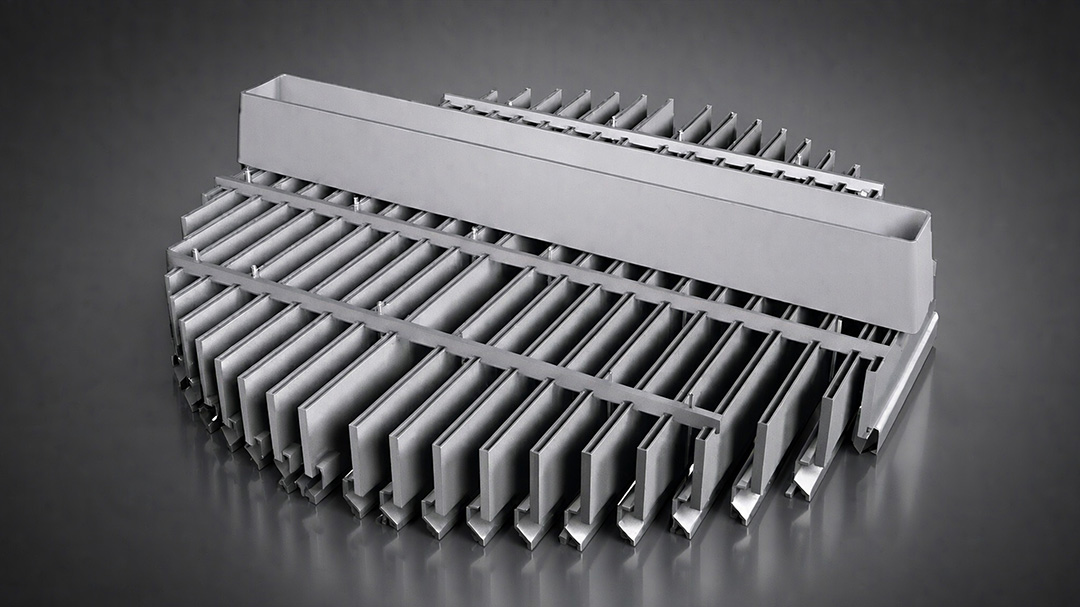
Figure 2: Pan vs drip-tube vs trough — same tower ID, different fouling/turndown trade-off.
Pressure-fed types use line pressure across orifices/nozzles. Cheaper, more vapor space, smaller lead-up pipe — but distribution quality is lower and small orifices plug.[2,5](@ref)
Header + branch pipes with metering orifices. ΔP ~1–5 psi. Good for scrubbers/strippers with high vapor velocity and limited height. Avoid suspended solids.[1](@ref)
Nozzles give fine coverage at low liquid rate (≈0.5 GPM/ft²) but ΔP 10–15 psi across nozzles, turndown ~2:1. Refinery/heat-transfer/short bed only; not for fractionation.[1,2](@ref)
| Type | Drive | Turndown | Fouling | Typical use |
|---|---|---|---|---|
| Orifice pan | Gravity | 2:1 | Low | Clean distillation, small–mid column |
| Drip-tube | Gravity | ~10:1 | Medium | Slightly dirty absorbent |
| Trough / V-weir | Gravity | 8–20:1 | High (V-weir) | Large tower, high L |
| Pipe-ladder | Pressure | ~3:1 | Low | Scrubber, tight height |
| Spray nozzle | Pressure | 2:1 | Poor | Refinery, short bed, heat transfer |
Turndown/ΔP ranges are generic reference (Mach/Munters); confirm with FXSINO hydraulic check for your fluid.[1,7](@ref)
| Packing | Points/m² (reference) |
|---|---|
| 50mm random packing | 30–50 |
| 25mm random packing | 50–80 |
| 250Y / 350Y structured | ≥90 |
| Wire-gauze structured (BX/CY) | >100 |
Source range per Moore–Rukovena DQ practice.[5](@ref)
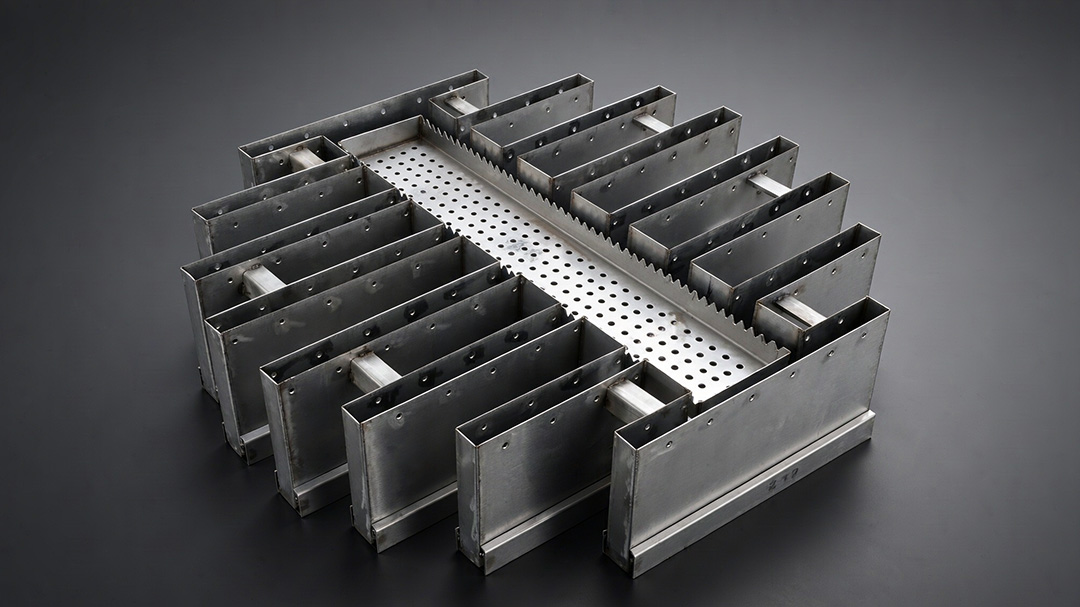
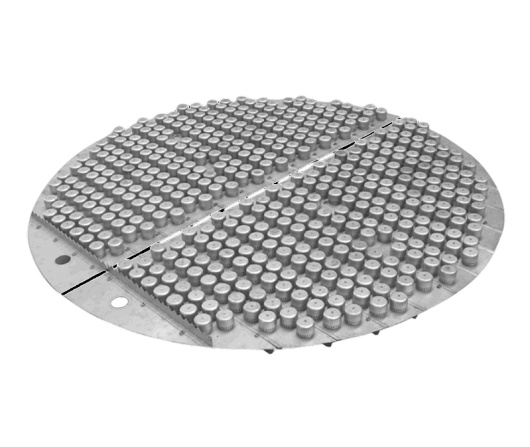
Figure 3: Distributor leveled on support ring — vapor risers clear of packing top, drip points aligned to bed area.
A top distributor is not enough for tall beds. Liquid drifts to the wall through the packing; without intermediate collection the lower bed channels. Rule of thumb: add a liquid collector & redistributor every ~15 theoretical stages (up to 20 with good hardware).[8](@ref)
| Symptom | Root cause | Fix |
|---|---|---|
| Efficiency drop | Orifice clog / maldistribution | Upsize orifice, add inlet strainer |
| High ΔP at top | Riser open area too low | Taller risers / trough type |
| Wall channeling lower bed | No redistributor | Add collector-redistributor |
| Dry patches at low load | Turndown too low | Drip-tube / trough / V-weir |
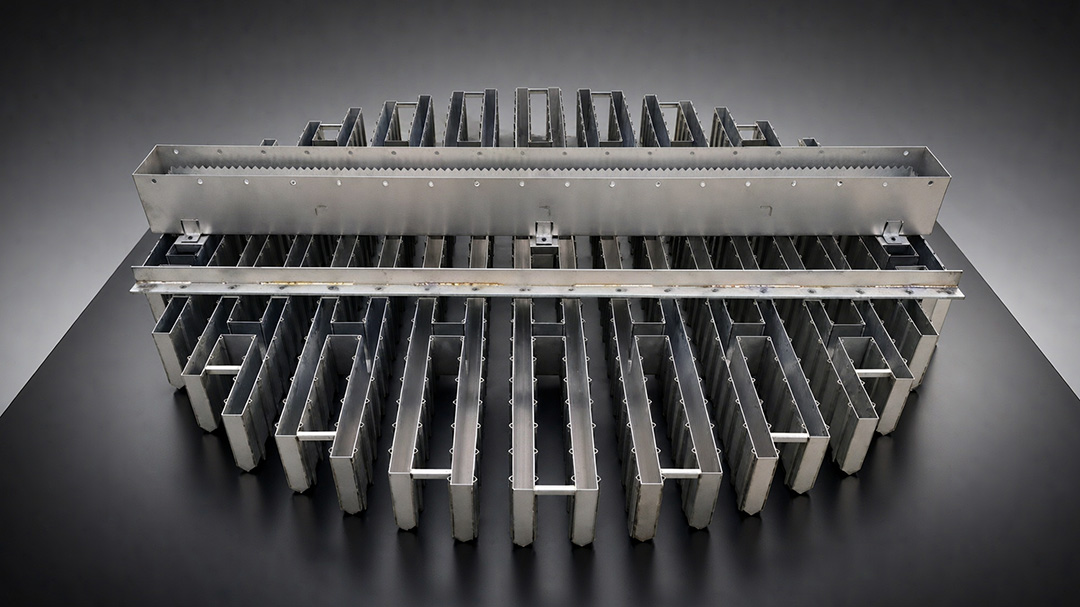
Figure 4: Uniform drip-point grid — no riser shadowing, edge points pulled in from wall.
Q: Small tower (<600mm) — pan or spray?
A: Clean service → orifice pan. Very low liquid rate and short bed → spray nozzle. Spray is not for fractionation because DQ is lower and nozzles clog.
Q: Fouling liquor with solids?
A: Skip plain orifice pan. Use drip-tube, trough with larger holes, or V-weir; keep orifice ≥4mm unless lab-proven.[5](@ref)
Q: Can I reuse the old distributor when changing packing?
A: Only if drip-point density matches the new packing and turndown covers the liquid range. Moving from 50mm random to structured packing usually forces a new distributor.
FXSINO is a manufacturer of packed-column internals — liquid distributors, redistributors, support grids, bed limiters and random/structured packing. Custom-orifice pans and troughs fabricated to tower ID.
Email: jackieqiu9202@gmail.com | +86 18507999558
 주소
: Intersection of Jinguang Avenue and Chongqing Middle Road, Anyuan Industrial Park, Anyuan District, Pingxiang City, Jiangxi
주소
: Intersection of Jinguang Avenue and Chongqing Middle Road, Anyuan Industrial Park, Anyuan District, Pingxiang City, Jiangxi 전화
: +86-18507999558
전화
: +86-18507999558 이메일
: sales@fxsino.com
이메일
: sales@fxsino.com 왓츠앱
:
+86-18507999558
왓츠앱
:
+86-18507999558





 IPv6 네트워크 지원